Smart Contract Audit Price: How to Lower Cost Without Lowering Security
If you searched for "cheap smart contract audit", "smart contract audit price", or "how to prepare for a smart contract audit", this guide is for you.
If you searched for "cheap smart contract audit", "smart contract audit price", or "how to prepare for a smart contract audit", this guide is for you. The useful question is not simply "who can audit this for the lowest price?" The useful question is: how do we remove avoidable audit work before a formal review starts, without hiding risk or shrinking the security scope that actually matters?
Audit price is driven by reviewer time, code complexity, protocol risk, timeline pressure, and the quality of the material you hand to the auditor. A team can reduce wasted time by freezing scope, writing useful documentation, testing important invariants, cleaning up obvious issues, and running a focused pre-audit readiness review. A team should not reduce cost by asking for a shallow review of fund-handling code, removing high-risk modules from scope, or treating an automated scan as a security audit.
TLDR
- A cheap smart contract audit is not automatically bad, but it is usually cheap because the scope, depth, reviewer seniority, timeline, or deliverables are limited.
- The best way to lower audit cost is to make the codebase easier to review: freeze scope, remove dead code, document the system, add meaningful tests, and fix obvious bugs before the formal audit.
- A pre-audit is a short readiness review before the formal audit. It should find design gaps, missing tests, unclear trust assumptions, and low-hanging vulnerabilities so the formal audit can focus on deeper issues.
- A pre-audit does not replace a formal audit. It is not a public assurance report and it should not be used as a launch badge.
- For more detail on quote ranges and cost drivers, read our smart contract audit pricing guide.
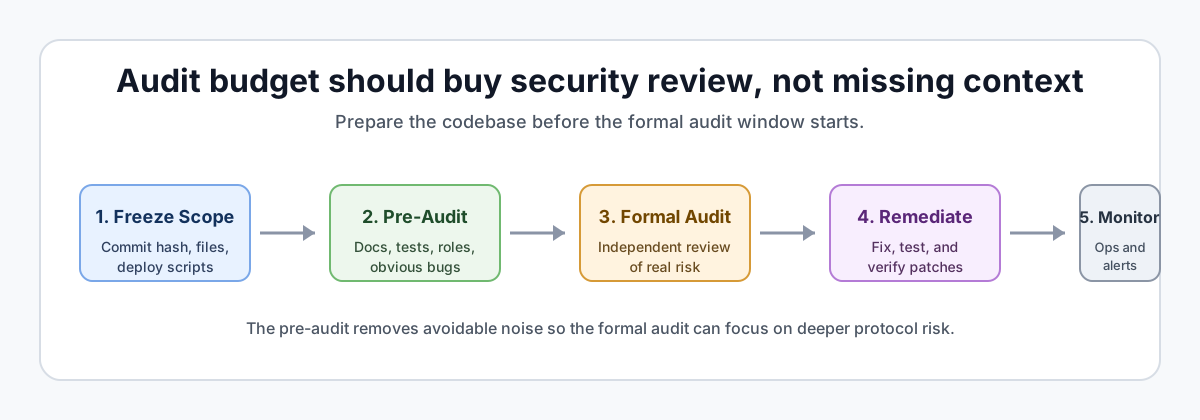
Table of Contents
- Why Audit Price Varies
- What a Pre-Audit Actually Is
- What Makes an Audit Expensive for the Wrong Reasons
- How to Prepare Before Asking for Quotes
- Pre-Audit Checklist
- What Not to Cut From Scope
- How to Compare Audit Quotes
- After the Audit
- Conclusion
- About Us
- FAQ
Why Audit Price Varies
Smart contract audit price is not only a function of lines of code. Two repositories can have the same size and completely different risk. A simple ERC-20 token with standard access control is not the same as a lending protocol with liquidations, price oracles, upgradeable proxies, and multiple privileged roles. The second system forces the auditor to reason about economic edge cases, external dependencies, governance delay, liquidation timing, rounding behavior, and failure modes across several contracts.
Auditors price work around time and uncertainty. The more uncertainty in the scope, the more time they need to reserve. A clean repository with a clear commit hash, a deployment plan, a roles table, test instructions, architecture notes, and known limitations is easier to quote. A repository with changing branches, unclear ownership, missing docs, and failing tests is harder to quote because the auditor has to spend early review time discovering basic facts.
This matters because audit time is expensive in two different ways. You pay for the auditor's time directly, and you also pay indirectly when your team pauses launch work, answers repeated questions, rewrites code mid-audit, and schedules follow-up reviews. An apparently cheap audit can become expensive if the scope was misunderstood or if the report forces a major redesign after the review has already started.
The goal is not to make the audit look easy. The goal is to make the actual risk visible. If your protocol handles user funds, controls privileged upgrades, depends on external prices, or performs accounting across multiple assets, those facts should be clear before the audit begins.
What a Pre-Audit Actually Is
A pre-audit is a readiness review conducted shortly before a formal audit. It is usually shorter and more collaborative than the formal audit. The point is to find obvious problems, missing context, incomplete tests, unsafe architecture decisions, and confusing implementation details before the auditor's formal review window starts.
It is useful to separate three activities:
| Activity | Purpose | Output |
|---|---|---|
| Automated scanning | Catch known patterns and easy mistakes | Tool output and triage notes |
| Pre-audit readiness review | Prepare the system for a deeper formal audit | Fix list, scope notes, test gaps, architecture feedback |
| Formal audit | Independent security review of the agreed scope | Public or private audit report with severity-ranked findings |
Automated scanning is not enough because tools do not understand protocol intent. A scanner can flag dangerous patterns, but it cannot decide whether a liquidation incentive is economically safe, whether a governance role has too much power, or whether a vault share calculation preserves value under all expected states.
A pre-audit is also not enough for launch assurance. It is normally conducted with less time, less independence, and a different objective. It helps the formal audit spend less time on clutter. It does not give the same signal as a full audit report.
The best pre-audit outcome is not "we found nothing." The best outcome is a short list of concrete changes that make the formal audit more productive: fix missing access controls, rewrite unclear accounting logic, add invariant tests, remove unused modules, write down trust assumptions, or split risky features into a later release.
What Makes an Audit Expensive for the Wrong Reasons
Some audit costs are legitimate. Complex protocols need time. Novel mechanisms need modeling. Cross-chain systems, account abstraction flows, upgradeable contracts, bridges, or liquidation engines should not be reviewed in a rush.
Other costs are avoidable. These are the ones a pre-audit should target.
Unclear Scope
Auditors need to know exactly what is in scope. "Review the repo" is not a scope. A usable scope names the commit hash, contracts, libraries, deployment scripts, chains, excluded files, privileged roles, and external dependencies. If a contract is excluded because it is only a mock, say that. If a dependency is assumed trusted, say that too.
Unclear scope creates duplicated work. The auditor reads files that are not meant to ship, misses files that are deployed through scripts, or spends time asking whether a module is legacy code. That time could have been spent on real attack paths.
Weak Documentation
Good documentation does not need to be long. It needs to answer the questions an auditor cannot infer safely from code alone:
- What is the protocol supposed to guarantee?
- Who can pause, upgrade, withdraw, reconfigure, or mint?
- Which external contracts are trusted?
- Which assets can be listed?
- What happens when an oracle is stale, paused, or manipulated?
- Which losses are considered acceptable design tradeoffs, and which are bugs?
The Solidity security considerations are useful background for common language-level pitfalls, but protocol-specific intent still needs to come from your team.
Tests That Only Prove the Happy Path
Auditors do not expect tests to prove security by themselves. They do expect tests to show that the team understands the important states of the system.
Unit tests should cover permissions, invalid inputs, rounding boundaries, failed external calls, pause states, upgrade paths, and accounting edge cases. Integration tests should show how contracts behave together. Invariant tests should capture properties that must remain true across many calls, such as "total shares cannot exceed accounted assets" or "a user cannot withdraw more value than they own." The Foundry invariant testing documentation is a practical reference if your stack uses Forge.
Tests also reduce quote uncertainty. If an auditor can run the suite locally and see what the team already checked, they can focus on untested assumptions instead of rebuilding the entire mental model from scratch.
Late Changes
Late changes are one of the simplest ways to waste audit budget. If code changes during a formal review, the auditor has to decide whether the change is isolated or whether it invalidates earlier reasoning. Even small changes can affect storage layout, access control, event assumptions, or accounting invariants.
Freeze the audit branch before the review starts. If a critical fix is needed during the audit, record it clearly and ask whether it should be reviewed as a diff or moved to a follow-up round.
Ignored Dependencies
Many protocol bugs live at integration boundaries. A contract may be locally correct but unsafe because it assumes too much about a token, oracle, bridge, proxy, or external callback.
If you use standard libraries, link the exact version and explain deviations. OpenZeppelin Contracts are common because they reduce custom implementation risk, but they still need correct configuration. Upgradeable deployments need extra care around initializers, storage layout, and admin permissions; the OpenZeppelin Upgrades Plugins documentation is a good starting point for those constraints.
If you use price feeds, document feed addresses, decimals, heartbeat assumptions, stale price handling, and fallback behavior. The Chainlink Data Feeds documentation explains the oracle interface, but your protocol still needs to define what it does when the feed is stale, unavailable, or economically unsafe for a given market.
How to Prepare Before Asking for Quotes
The strongest way to reduce audit price without weakening security is to prepare a quote package. This helps auditors estimate effort accurately and helps your team compare quotes on the same basis.
A good quote package includes:
- Repository URL and exact commit hash.
- List of in-scope contracts and deployment scripts.
- List of out-of-scope contracts with reasons.
- Target chains and deployment addresses if any contracts are already live.
- Architecture diagram or written module map.
- Roles and permissions table.
- External dependencies and trust assumptions.
- Known risks, known limitations, and unresolved design questions.
- Test instructions, coverage notes, and important invariant tests.
- Expected audit timeline and whether scope will be frozen.
- Desired deliverables: report, remediation review, private call, public PDF, or contest triage.
Do not hide known issues to see whether the auditor finds them. That wastes time and weakens the review. Known issues should be disclosed with context: why they exist, whether they are intended to be fixed before launch, and what impact they may have. The auditor can then decide whether the issue hides deeper problems.
It also helps to read public reports before commissioning your own audit. Trail of Bits publishes audit reports that show the level of detail a high-quality review can include. Code4rena publishes contest reports that show how crowdsourced findings are grouped, judged, and remediated. These are different models, but both help teams understand what useful security feedback looks like.
Pre-Audit Checklist
Use this checklist before sending code to a formal auditor. It is intentionally practical. The goal is to remove noise, not to pretend the protocol is already secure.
1. Freeze the Release Scope
Pick a commit hash. Confirm which contracts are intended for deployment. Remove abandoned code or mark it out of scope. Make sure deployment scripts point to the same contracts the auditor is reviewing.
If you cannot freeze scope yet, you may not be ready for a formal audit. In that case, ask for an architecture review or pre-audit instead.
2. Write the Threat Model
A threat model can be short. It should define assets, actors, trust assumptions, and failure cases. For example:
- Assets: user deposits, protocol reserves, governance tokens, pending withdrawals.
- Actors: users, keepers, governance, admin multisig, oracle operators, borrowers, liquidators.
- Trust assumptions: which roles are trusted, which external contracts are assumed correct, which assets are non-standard.
- Failure cases: stale oracle, paused bridge, blocked withdrawals, bad upgrade, compromised privileged key.
This prevents auditors from guessing whether an outcome is a bug or an accepted design tradeoff.
3. Build a Roles and Permissions Table
Most serious protocols have privileged actions. List them. Include the role, function, effect, delay, multisig threshold, emergency process, and expected post-launch owner.
This is also where code security meets operational security. A perfect contract can still be drained through a compromised admin key or a careless upgrade process. For that broader attack surface, see our guide on Web3 OpSec attack patterns.
4. Run the Test Suite From a Clean Machine
If the auditor cannot run your tests, the first audit day becomes environment setup. Write down tool versions, environment variables, fork RPC requirements, and known flaky tests. If tests need private RPC endpoints or API keys, provide a safe way to run them.
Passing tests are not enough. The suite should include negative tests and edge cases. If a function should revert for unauthorized users, test that. If rounding matters, test boundary values. If a protocol state should never happen, write an invariant or an explicit assertion.
5. Review Upgradeability and Storage Layout
Upgradeable contracts are not just normal contracts with a proxy in front. The initializer, storage layout, admin role, implementation address, and upgrade process are all part of the security model. A pre-audit should check whether initializer functions can be called twice, whether storage gaps are used consistently, whether implementations are locked where appropriate, and whether the admin can accidentally bypass governance.
6. Document Oracle and Market Assumptions
Any protocol that relies on external prices should document oracle selection, decimals, update cadence, stale price behavior, circuit breakers, and market listing criteria. If a market can be created permissionlessly, explain how unsafe assets are prevented. If listing is permissioned, explain who controls it and how mistakes are corrected.
Oracle assumptions often look obvious to the core team because they were discussed in calls. Auditors were not in those calls. Write them down.
7. Remove Low-Value Findings Before the Audit
Fix compiler warnings. Remove dead imports. Pin dependency versions. Use consistent formatting. Add NatSpec where function intent is not obvious. Avoid floating pragmas in production contracts unless you have a deliberate reason.
These changes do not make the protocol secure on their own, but they keep the final report from being crowded by issues the team could have fixed internally.
What Not to Cut From Scope
Reducing audit cost by excluding high-risk code is usually a false saving. The highest-risk modules are the ones most worth reviewing.
Do not exclude:
- Upgrade contracts, proxy admin logic, or initialization paths.
- Oracle adapters and price conversion code.
- Withdrawal, redemption, liquidation, and settlement paths.
- Governance execution, timelock, and emergency controls.
- Token listing, collateral onboarding, or market creation logic.
- Accounting libraries shared by multiple modules.
- Deployment scripts that assign ownership or initialize critical values.
It can be reasonable to split a large project into phases. For example, a protocol may audit the core vault and accounting first, then audit new strategies in a later round. But the split should follow real deployment boundaries. If two modules will be live together and can affect each other, reviewing them separately may miss cross-module bugs.
How to Compare Audit Quotes
Do not compare quotes only by price. Compare what the quote actually includes.
Ask each auditor:
- How many reviewers will be assigned?
- How much calendar time and reviewer time is included?
- Is remediation review included?
- Will the report be public or private?
- Is threat modeling included, or only code review?
- Are tests, deployment scripts, and external integrations in scope?
- How will late changes be handled?
- What severity framework will be used?
- Will there be a kickoff call and a findings review call?
- Are automated tools used as support, or is the review primarily manual?
Cheap can be acceptable for a narrow, low-risk module with standard patterns and no live funds. Cheap is dangerous when it is used to review complex fund-handling logic, rushed launch code, or a system whose trust assumptions are still changing.
The public ethereum.org smart contract security guide is a useful reminder that smart contract risk comes from both code-level bugs and the adversarial environment around deployed contracts. A good quote should account for that environment, not just count files.
After the Audit
The audit is not finished when the report arrives. The team still needs to fix issues, review patches, avoid introducing new bugs, and decide whether a follow-up review is required.
For each finding, track:
- Severity.
- Root cause.
- Fix commit.
- Whether the fix needs auditor verification.
- Whether tests were added.
- Whether documentation or runbooks changed.
- Whether the issue implies a larger design problem.
Do not treat "acknowledged" as a passive label. If the team accepts a risk, explain why. Maybe the issue is impossible under current market listing rules. Maybe it only affects a deprecated path. Maybe the fix creates a worse tradeoff. That reasoning should be written down because future maintainers will not remember the original discussion.
After fixes, ask whether the changes are small enough for a diff review or large enough for a new review. A patch that changes core accounting deserves more scrutiny than a NatSpec update.
Finally, remember that audits do not cover everything. They usually do not secure private keys, deployment laptops, frontend hosting, governance operations, RPC providers, or incident response. Post-launch security should include monitoring, alerting, role hygiene, bug bounty planning, and an emergency process that the team has actually rehearsed.
Conclusion
The best way to get a cheaper smart contract audit is not to buy the thinnest review. It is to reduce uncertainty before the formal audit starts.
Prepare the codebase. Freeze scope. Explain the protocol. Write tests that cover failure states. Document roles, oracles, upgrade paths, and known risks. Use a pre-audit to catch obvious issues and missing context, then reserve formal audit time for the hard questions: can the protocol lose funds, break accounting, be upgraded unsafely, or behave incorrectly under adversarial conditions?
That is how audit budget turns into security value instead of a long report full of avoidable findings.
About Us
SC Audit Studio works on smart contract security reviews, protocol risk analysis, and audit readiness for teams preparing to launch or upgrade on-chain systems.
Reach out for audit readiness, formal security assessments, or scoped review questions.